
13 July
Articles & Advice
Brand positioning: the foundation every marketing strategy must be built on
- becky
- 0 Comments
Brand positioning: the foundation every marketing strategy must be built on
What brand positioning actually means
Brand positioning is one of the most used terms in marketing and one of the most misunderstood in practice.
Research from Harvard Business School describes brand positioning as staking out a specific piece of mental real estate in the mind of your target audience — not what you intend to project, but what a buyer actually recalls and associates with your brand when a purchasing decision arises. That distinction matters enormously. A positioning statement expresses how you wish to be perceived. Your actual position is determined by your audience.
Mental availability and why it is the real competitive advantage
This is the foundation of two concepts that serious marketers work hard to build: mental availability and brand salience. Mental availability is the likelihood that your brand comes to mind in a buying situation. Brand salience is the strength and clarity of the associations that make that recall meaningful. In B2B markets — where purchasing decisions involve multiple stakeholders, long cycles and often marginal functional differences between competitors — the brand that is recalled clearly and consistently holds a structural commercial advantage over the one that is not.
The three-word challenge
Here is the reality that most business leaders underestimate. Research suggests consumers encounter up to 700 brand impressions in a single day. They are not thinking about your brand anywhere near as much as you are. This is precisely why a brand position needs to be distilled to its sharpest possible form — ideally three words that capture a distinctive, credible and relevant claim. Not a tagline. Not a values statement. Three words that define where you sit in the mind of your buyer relative to every alternative they could choose.
The B2B positioning challenge
In B2B markets this is particularly challenging because true functional differentiation is often limited. Research from Harvard identifies the concept of points of difference — those attributes, benefits or values that are genuinely unique to your business — as distinct from points of parity, which are simply the entry-level expectations every competitor in your category must meet. Strong positioning requires honest analysis of both: what you share with competitors and what you can credibly own that they cannot.
The long and the short of it
Brand positioning operates on a long time horizon. It is aimed at all potential buyers in your target market — including the majority who are not actively looking to buy right now. Its role is to build the mental availability that means your brand comes to mind when a buying situation eventually arises. This is fundamentally different from short-term demand generation, which targets active buyers and drives immediate conversion. Both matter commercially, but they operate at different speeds and serve different purposes. Positioning is the long game. It should not change with campaigns, market conditions or internal opinion.
How the position is built
The process of arriving at a position is as important as the position itself.
At Platinum Mix, brand positioning is developed through a structured workshop with business leaders and key stakeholders rather than presented to them as a finished output. That distinction is deliberate. When the people who lead and represent the business are taken through the thinking — the competitive landscape, the target audience and the honest assessment of what the brand can credibly own — they shape the outcome rather than receive it. That shared ownership changes how consistently the positioning is applied across the organisation and consistency is ultimately what makes it work.
The workshop draws out what the business genuinely stands for, how it is perceived externally versus how it sees itself and where a defensible and distinctive position exists in the market. The result becomes the foundation from which every subsequent marketing decision is made.
A foundation, not a tactic
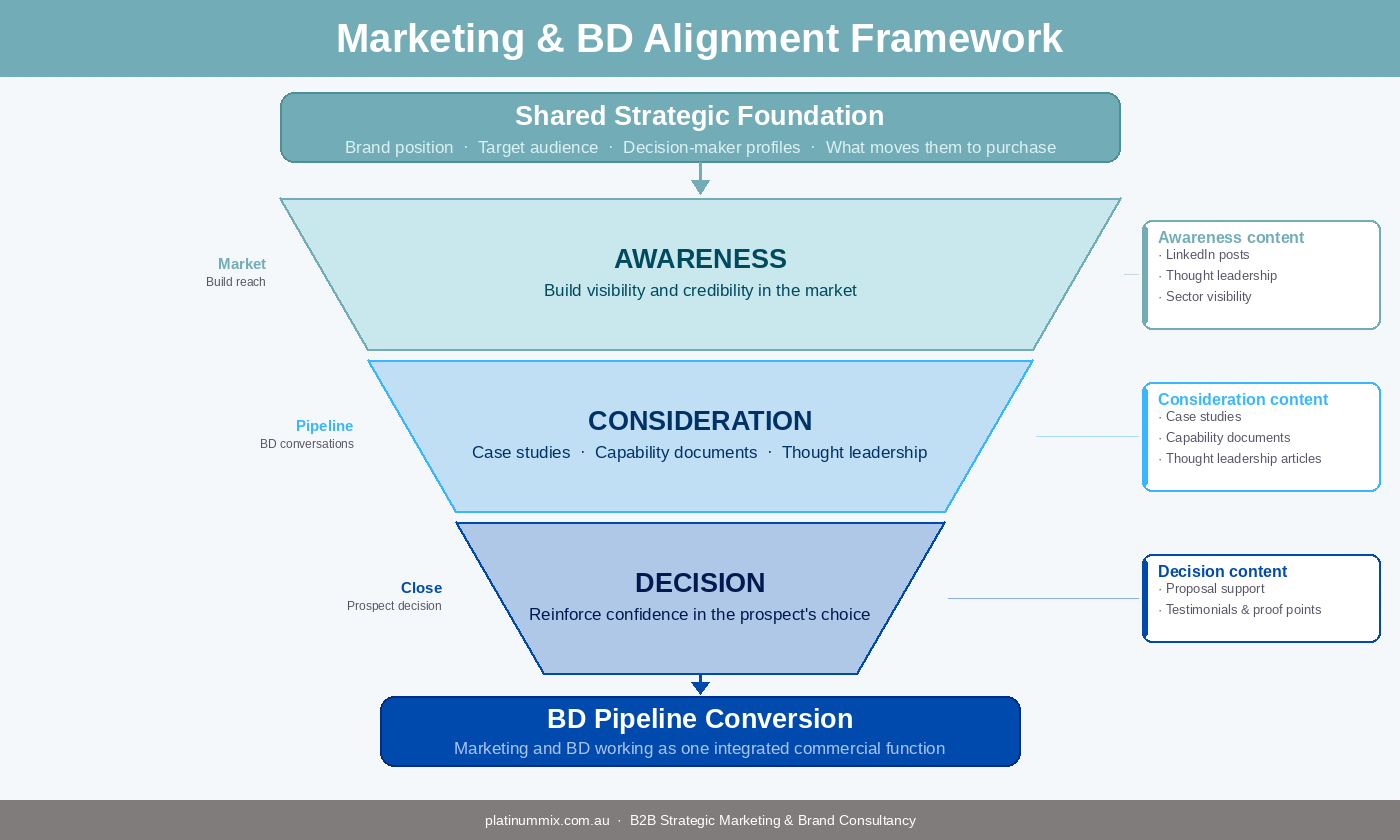
Strategy, messaging, content, sales collateral and go-to-market planning all follow from it. The businesses that build the strongest market presence over time are the ones that define their position clearly, commit to it for the long term and let everything else follow.
Related Posts
- platmixdev
- January 16, 2026