
When Marketing and Sales work together, growth follows
Two teams. One goal. So why are they pulling in different directions?
In most small and mid-sized B2B businesses, the founder or MD owns both marketing and business development functions. Sometimes directly. Sometimes through a small team. Either way, the responsibility for revenue growth sits firmly on one desk.
And yet, for many businesses, marketing and BD operate in silos. Marketing produces content, campaigns and collateral. BD works the phones, attends industry events and manages the pipeline. The two functions run in parallel rather than in partnership. And the result is that neither performs as well as it should.
If that sounds familiar, you are not alone. It is one of the most common growth constraints I encounter in B2B businesses — and one of the most straightforward to fix once it is clearly diagnosed.
How to tell if the problem exists in your business.
The misalignment between marketing and BD rarely announces itself loudly. It tends to show up in subtler ways that are easy to attribute to other causes.
Your BD team is spending significant time educating prospects about what the business does and why it matters — time that well-targeted marketing content should already have invested before the conversation begins. Your marketing activity feels disconnected from the actual sales process. Campaigns go out that the BD team did not know about, or did not see the relevance of. Collateral gets produced that nobody uses. Content is created for its own sake rather than to support a specific stage of the pipeline.
At a leadership level, it often shows up as a quiet frustration on both sides. BD feels that marketing is not supporting them in any practical way. Marketing feels that BD does not engage with or value what they produce. And the MD, sitting across both, is not entirely sure whose version of events is correct.
The underlying issue is almost always the same. The two functions are not working from the same strategic framework, towards the same defined objectives, with a shared understanding of the customer journey they are both trying to move prospects through.
Why it matters more in B2B than anywhere else.
In consumer marketing, the path from awareness to purchase can happen quickly and with limited human interaction. A customer sees an ad, visits a website, makes a decision. The marketing does most of the work.
In B2B, and particularly in sectors like energy, mining and resources services (METS) sales cycles are longer and more complex. Purchase decisions involve multiple stakeholders. Trust is built incrementally over months, sometimes years. And the relationship between marketing activity and commercial outcome is rarely direct or immediate.
This is precisely why the alignment between marketing and BD is so critical in a B2B context. Marketing is not trying to close a sale. It is trying to create the conditions in which BD can close a sale more efficiently. It builds awareness before the first conversation. It maintains visibility during a long evaluation period. It reinforces credibility between touchpoints. It gives BD better conversations to have, with better-informed prospects, at every stage of the pipeline.
When marketing understands its role in the sales process — and BD understands the value of what marketing is building ahead of each conversation — the two functions stop working in parallel and start working as a single, coordinated growth engine.
What alignment actually looks like in practice.
This does not require a restructure or a significant investment. For most B2B businesses, it requires three things done consistently.
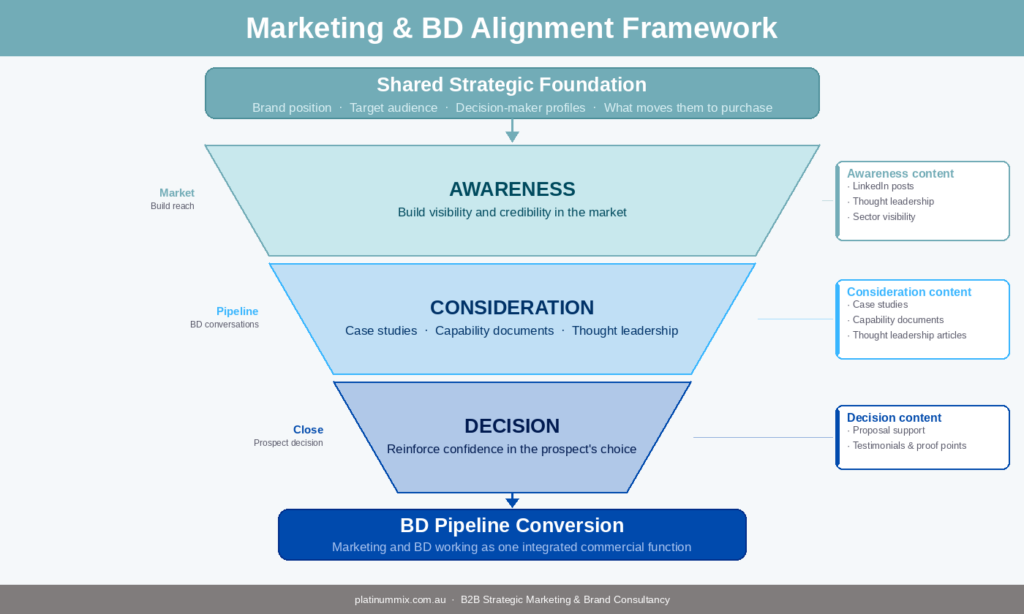
- The first is a shared understanding of the customer. Marketing and BD should be working from the same strategy starting with a clear and defined brand position and target audience — the same sectors, the same decision-maker profiles, the same understanding of what those people care about and what moves them through a purchasing decision. If marketing is targeting one audience and BD is having conversations with another, the disconnect will show up everywhere.
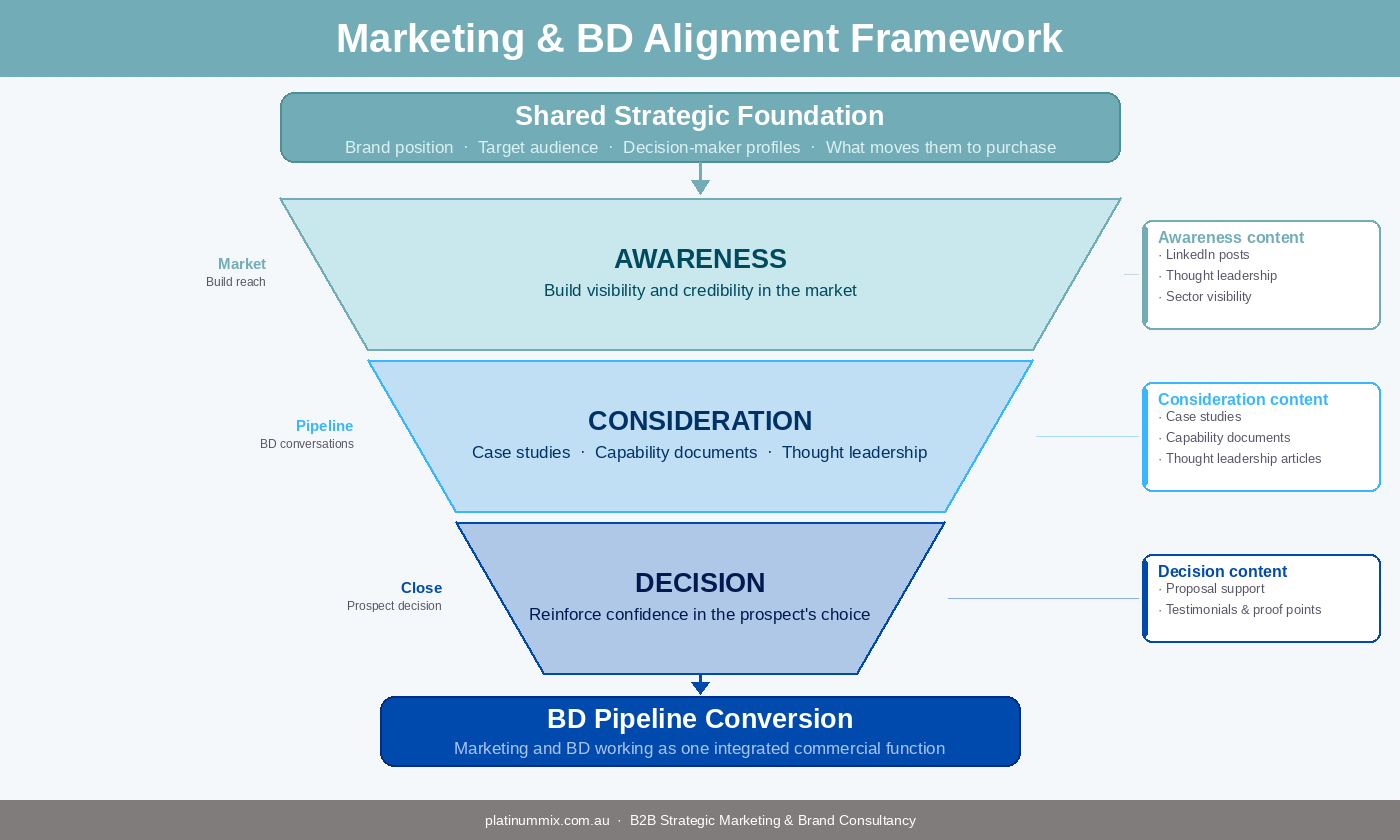
- The second is a content and campaign plan that maps directly to the sales pipeline. At the awareness stage, marketing builds visibility and credibility in the market. At the consideration stage, it provides the content and proof points that support BD conversations — case studies, capability documents, thought leadership articles that answer the questions prospects are already asking. At the decision stage, it reinforces confidence and trust in the choice the prospect is about to make. When content is built around the pipeline rather than around what is easiest to produce, it becomes genuinely useful to BD rather than something that exists in parallel to the sales process.
- The third is a regular rhythm of communication between the two functions. This does not need to be complex. A monthly conversation where BD shares with marketing what they are hearing in the market — the objections, the questions, the competitive dynamics — and marketing shares what the data is showing about what content and channels are performing, is enough to keep both functions genuinely informed and genuinely useful to each other.
The commercial case for getting this right.
When marketing and BD are aligned, the effects compound over time in ways that are commercially significant.
BD conversations start further down the sales process because prospects already have a clear understanding of the business and what it stands for. Sales cycles shorten because marketing has already answered the questions that would otherwise slow the conversation down. Win rates improve because the business is showing up consistently and credibly at every stage of the evaluation process. And the cost of business development — in time, effort and resource — reduces because marketing is doing meaningful work ahead of every conversation.
For a B2B business in a competitive sector, where every significant contract requires a sustained investment of BD time and effort, those gains are not marginal. They are material.
A question worth sitting with.
Growth rarely stalls because a business lacks effort. It stalls because effort is not coordinated or strategic. Marketing works hard. BD works hard. But if they are not working in the same direction, from the same strategy, towards the same objectives, the combined output is less than the sum of its parts.
In your business, does your marketing activity make your BD team’s conversations easier — or does it operate largely independently of them? Because the answer to that question says a great deal about where your next growth opportunity is waiting.
Related Posts
- platmixdev
- January 16, 2026
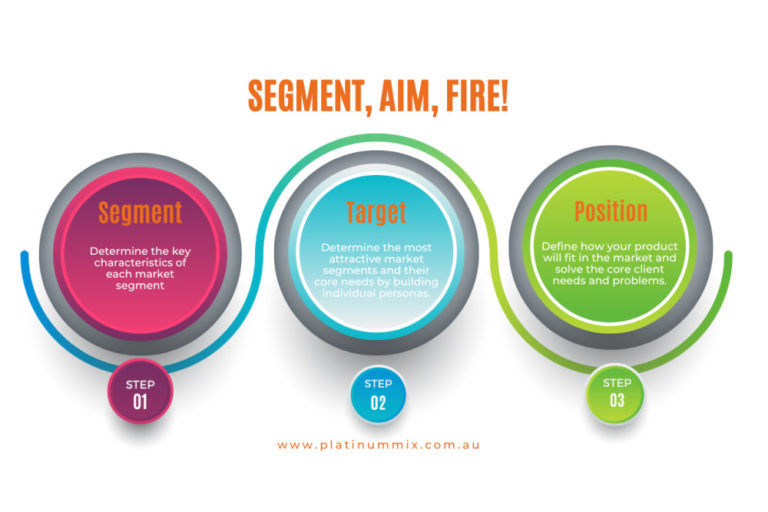
Segment, aim and fire!

Leave A Comment Cancel reply
You must be logged in to post a comment.